Are there any professionals working in the field of treating victims of sex crimes, abuse or trauma in New Zealand supporting the ACC sensitive claims clinical pathway, questions the National Council of Women of New Zealand (NCWNZ).http://www.scoop.co.nz/stories/PO0911/S00251.htm
“The Doctors for Sexual Abuse Care certainly don’t,” said Elizabeth Bang, NCWNZ National President. “Likewise Social Workers, Counsellors, Therapists, Psychotherapist, Clinical Psychologists, Specialist Sexual Violence Agencies (SSVAs), Community Support Agencies, such as the National Collective of Independent Women’s Refuges, Massey University, the NCWNZ and the average person on the street – are all singing from the same song-sheet. The assessment system needs to be rolled back to what was in place before the clinical pathway, the clinical pathway needs to be reviewed immediately, and ALL specialists in the field, academia, medicine, community representatives need to be invited to ACC’s consultation table.”
NCWNZ’s perspective on the clinical pathway is that the policy is blatantly discriminatory.
“An analysis according to the Convention on the Elimination of All Forms of Discrimination Against Women (CEDAW) has been undertaken on what effects this policy has now and in the future,” said Elizabeth Bang. “The fact that fewer victims of trauma are presenting themselves for assessment and recovery ticks the first box in demonstrating the current clinical pathways are a discriminatory barrier.”
Women are the main users of ACC subsidised treatments for recovery. An estimated 30% of women in New Zealand will be victims of sex crimes. Within this group, many women will experience trauma, which requires treatment for them to recover and advance in life. Women are also the major providers of community-based sexual violence and victim support; the social work, therapist and counselling professions. No longer having the ability to provide an assessment undermines the viability and retention of these services. The DSM IV diagnostic tool, now used for assessments, classifies women as having mental illness, thereby limiting their access to insurance, mortgages, and advancement in employment.
NCWNZ believes that the sensitive claims “clinical pathway” causes the following direct and indirect discrimination under CEDAW:
“The clinical pathway, without any professional support has literally imploded,” says Elizabeth Bang.
- Article 3: limiting a women’s opportunity for functionality and advancement in all facets of life.
- Article 5: limiting a woman’s opportunity to modify the social and cultural patterns of conduct; no longer accessing essential skills to break cycles of violence, intergenerational dysfunctionality, which in the longer term may result in an increase in criminal behaviour in the community.
- Article 6: limiting youth’s ability to access recovery treatment (ECPAT: 64% of underage prostitutes have historically been victims of sex crime) and potentially increasing the level of prostitution and sexual exploitation with less youth/women moving out of the sex industry.
- Article 7: creating a financial barrier for women re-presenting for further recovery treatment, and reducing women’s participating in the formulation of government policy, holding public office and performing all public functions at all levels of government.
- Article 10: without recovery, fewer women will present themselves for continuing education. Potentially more girls will leave school in advance of completing their qualifications.
- • Article 11: limiting a woman’s opportunity for promotion in employment, increasing the likelihood of substandard performance, increasing the vulnerability to exploitation and sexual harassment, market shrinkage in the ‘recovery’ professions.
- Article 12: increasing teenage pregnancy, increasing levels of STI’s, increasing levels of self-harm and suicidal tendencies.
- Article 13: limiting economic opportunities, limiting the financial independence of ‘recovery’ professionals, limiting women’s ability to enjoy social life at an equal level to men’s.
- Article 14: women residing in rural areas are the sub-grouping most adversely affected by the changes implement through the clinical pathway. The level of discrimination increases further if they are also of Maori, Pacific or any other ethnicity, other than NZ-European.
- Article 16: limiting the ability of victims of sex crimes, who have experienced trauma, to recognise and break cycles of violence and poor functionality.
“NCWNZ encourages the Minister of ACC to take the necessary action that all believe he wishes to take. The Minister doesn’t have time to support this nonsense, it’s time to intervene,” concludes Elizabeth Bang.

24 November 2009
Is there anybody out there?
Press release from NCWNZ


22 November 2009
Real reasons for change in abuse claims policy
Press release from the New Zealand Association of Counsellors
ACC comes clean about real reasons for change in sexual abuse claims policyhttp://www.scoop.co.nz/stories/PO0911/S00234.htm
ACC Southern Manager Karen Walsh, speaking at Fairlie Lions Club on Thursday 19 November revealed that it is ACC policy to reduce the number of Sensitive Claims.
In October ACC introduced a new “pathway” which involves forcing claimants to undergo a psychiatric assessment prior to their claim being accepted. This policy has had the effect that ACC wants; a serious reduction in accepted claims. The Sensitive Claims Unit are declining claims in much greater numbers than previously and therefore preventing the victims of sexual crimes from getting the treatment and rehabilitation they need and are entitled to in the law.
"ACC have been using spurious excuses for these changes” said NZAC spokesperson Elayne Johnston; “first they said that the changes were made to comply with Guidelines produced by Massey University. This has not stood scrutiny and Massey have distanced themselves from ACC and the use of their name to support punitive policies”.
"As we suspected the real reasons for these changes have now been revealed, it is about money not the provision of services to victims of sex crimes.”
“In the meantime many victims of sexual crimes are suffering the humiliation of psychiatric diagnosis, or not coming forward at all. Many of those who continue to seek help are having their claims declined. This is the equivalent to not being believed, a common experience of both adult and child victims of sex crimes.”
“Every day I receive emails from members about clients’ claims that are being declined for a range of reasons that include:
Members also report a significant drop in the number of people coming forward for help; I believe the new scheme is putting them off.”
- Previous history of psychological problems
- Inability to access GP’s notes
- Claimant for childhood abuse being in a “dysfunctional family”.
- Incident took place “too long ago”.
“It is very difficult ethically for our members to be part of a system that has so much potential for harm” says NZAC Ethics Convener, Eric Medcalf. “That this system has been created by health professionals with their own ethical codes, all of which will direct that they “do no harm”, makes me sure that in the long run they are vulnerable to personal ethical investigation”.
It is time that the government recognised the sham of this ACC change and commissioned an enquiry into services for victims of sex crimes.
20 November 2009
Research show social cost of sexual violence
An article from The Star by Brenda Harwood
Sexual violence in New Zealand is significantly under-reported, with just 9 per cent of assaults reported, but it is our most costly crime with an estimated social cost of $1.2 billion per year.http://www.odt.co.nz/news/dunedin/82676/research-show-social-cost-sexual-violence
This is one of the key findings in the Ministry of Women's Affairs report Responding to Sexual Violence: Attrition in the New Zealand criminal justice system - one of four related research reports released this month.
On a visit to Dunedin last week, Ministry chief executive Shenagh Gleisner told The Star sexual violence was a largely invisible crime and that family and friends needed to step up to help.
"The whole community needs to recognise the problem that sexual violence represents," Ms Gleisner said.
The four studies, tied together into the report Restoring Soul: Effective Interventions for Adult Victim/Survivors of Sexual Violence, arose from a two-year research project led by the Ministry of Women's Affairs in partnership with the Ministry of Justice and the New Zealand Police.
The report includes an analysis of about 2000 sexual violation cases recorded by police over a 30-month period.
Of these, only about 16 per cent proceeded to trial and 13 per cent resulted in a conviction.
The report showed that the reaction sexual violence survivors receive from friends and family is a crucial factor in their path to recovery.
A positive reaction helped survivors to take the next step toward recovery, or to report the crime to police, Ms Gleisner said.
"It is a sad fact that some victims can encounter disbelief, blame and ostracism.
It is absolutely critical that they are believed and supported when they find the courage to tell someone what has happened to them."
The report also dispelled some myths, including that of "stranger danger" rape, showing that most sexual violence was committed by someone known to the victim, Gleisner said.
The report and other research would go forward to government to help provide a basis for policy and operational responses.
"We will be strongly encouraging the use of this research across a broad range of agencies to help improve services and systems.
"However, we shouldn't just wait for the government to handle it - there is a great deal that everyone can do in their own homes and streets right now," Ms Gleisner said.
17 November 2009
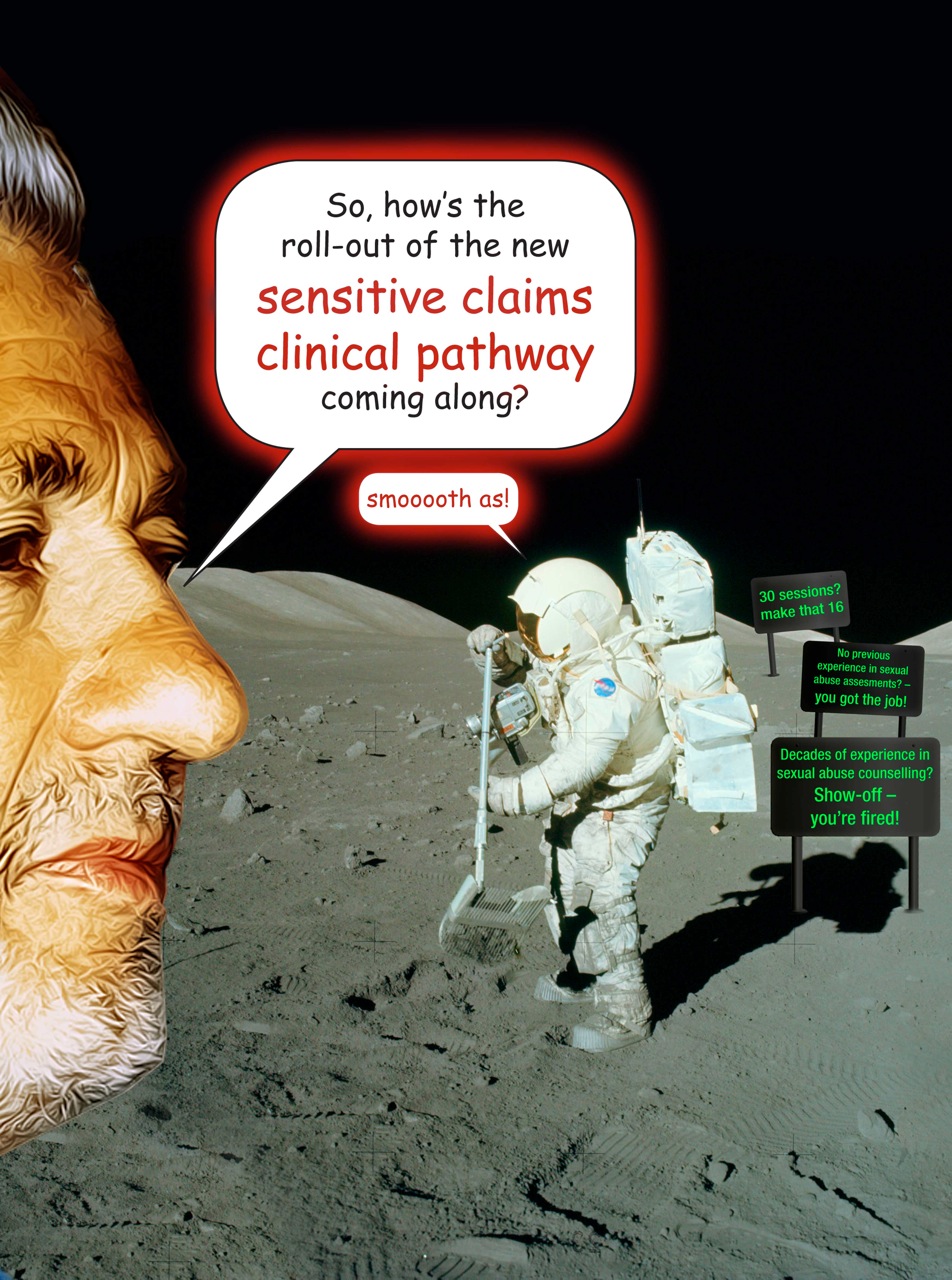
As 'Smooth' as the Surface of the Moon
Press release from NCWNZ

The last two weeks have seen the implementation of the new ACC clinical pathway for sensitive claims and the transition has been anything but ‘smooth’, says the National Council of Women of New Zealand (NCWNZ).http://www.scoop.co.nz/stories/PO0911/S00160.htm
“Implementation was always going to be haphazard and risky,” says Elizabeth Bang, NCWNZ National President. “This is what happens when the service providers are ignored, and are expected to apply a diagnosis based on a system that few in New Zealand are qualified to administer.”
ACC implemented the new clinical pathway against a backdrop of professional dissension. Massey University, the authors of the research report used as the basis for the process change, has publicly removed itself from any responsibility for ACC’s decision-making, when it comes to the partial, fragmented implementation of the guidelines.
“The situation on the ground is best described as chaotic,” says Elizabeth Bang.
NCWNZ has to date heard that:
NCWNZ acknowledges that it is not unusual or uncommon for survivors to undergo more than one consolidated period of counselling or therapy. Often the survivor can only process so much change in their behaviour and lives that to push beyond that level could be less effective and too risky for the client. Also, life changing events such as parenthood, death of a loved one, economic downturn, such as a recession can trigger behaviour in a survivor that requires support, and from there an enhanced level of recovery can be achieved.
- The severe workforce shortage of those eligible practitioners who can give a diagnosis using the DSM IV criteria is causing considerable delay and inappropriate and unethical assessment processes.
- It appears that psychologists are being flown around the country to assess victims in their homes because they do not have premises in that location.
- The use of assessors who have no history or training in sexual abuse.
- Counsellors and therapists who are not currently eligible to give a diagnosis using DSM IV, are having to submit claims for clients which ACC will use for making referrals to the DSM IV qualified assessors. This significantly lengthens the process before a client knows if the claim will be accepted, and essentially captures the counsellors and therapists as “middle” women and men, rather than the previous position they held which ensured the claims could be approved in a more acceptable timeframe.
- The benefit of counsellors and therapists being able to undertake assessments themselves meant they could also respond to the acute presenting need of the client for stabilisation, containment and risk assessment. This is now not being done before the very delayed assessment process.
- ACC subsidises counsellors and therapists for a one hour session when preparing the ACC 45 claims, this includes the consultation time with the client. On average it is taking 90 minutes to prepare such material as the session notes, and all other relevant information to support the claims are included. The system places pressure on the provider to work without pay, to provide the fullest and best possible material to support the client within a specific time constraint. The client is caught having to discuss their traumatising event(s) in a manner that could be likened to a factory-line.
- Previously, survivors who historically had an accepted claim, but at a later date presented for further help could do so to an ACC registered counsellor. A report would be generated following one ACC subsidised session. This system has now been removed; a survivor will need to meet the entire cost of the session, or a counsellor will have to go without payment for service. Only a letter of referral and supporting information can be submitted to justify why further treatment should be provided.
“Had the views of the sector been considered in the months and weeks leading up to the roll-out of the clinical pathway,” says Elizabeth Bang, “then ACC’s belated desire to talk would not appear so farcical. All believe that building upon the pathway following its implementation smacks of experimentation, with the victims of sex crimes being the guinea pigs.”
The adoption of the diagnostic tool has the effect of pitting one key section of the service provision, counsellors, social workers and therapists, against the other, clinical psychologists and psychiatrists.
As an educator and advocate for women, children and families, NCWNZ deplores the actions taken by ACC, and further notes the support of the Minister of ACC in this debacle.
“We will not keep these ongoing concerns and problems behind closed doors,” says Elizabeth Bang. “The public demands transparency.”
NCWNZ is awaiting a response from the Minister of ACC, Hon Nick Smith regarding its request that the review of the system be immediately undertaken and the implementation of the new scheme halted.
“We are hopeful that the Minister will respond favourably to our request. We are however prepared to escalate the issue, as simply from the user perspective alone, what has transpired is discriminatory,” concluded Elizabeth Bang.
12 November 2009
Questions for written answer
18243 (2009). Hon David Parker to the Minister for ACC: How many sensitive claims did ACC receive each month in 2008 and how many of these were declined broken down by claim category?
Hon Dr Nick Smith (Minister for ACC) replied: Corrected reply: I refer the Member to the attached table.
http://www.parliament.nz/en-NZ/PB/Business/QWA/5/0/e/QWA_18243_2009-18243-2009-Hon-David-Parker-to-the-Minister-for-ACC.htm
18244 (2009). Hon David Parker to the Minister for ACC: What is the average length of time it has taken ACC to determine whether to accept or decline a sensitive claim for the year to the end of September and how does this compare to the previous year?
Hon Dr Nick Smith (Minister for ACC) replied: I refer the Member to the attached table.
http://www.parliament.nz/en-NZ/PB/Business/QWA/6/9/8/QWA_18244_2009-18244-2009-Hon-David-Parker-to-the-Minister-for-ACC.htm
Hon Dr Nick Smith (Minister for ACC) replied: Corrected reply: I refer the Member to the attached table.
http://www.parliament.nz/en-NZ/PB/Business/QWA/5/0/e/QWA_18243_2009-18243-2009-Hon-David-Parker-to-the-Minister-for-ACC.htm
18244 (2009). Hon David Parker to the Minister for ACC: What is the average length of time it has taken ACC to determine whether to accept or decline a sensitive claim for the year to the end of September and how does this compare to the previous year?
Hon Dr Nick Smith (Minister for ACC) replied: I refer the Member to the attached table.
http://www.parliament.nz/en-NZ/PB/Business/QWA/6/9/8/QWA_18244_2009-18244-2009-Hon-David-Parker-to-the-Minister-for-ACC.htm
Subscribe to:
Posts (Atom)